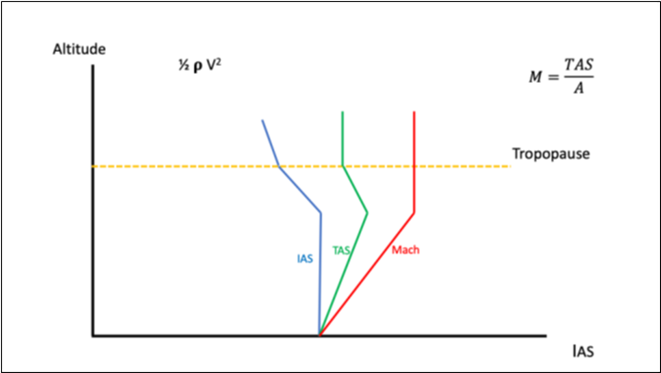
CTM known as Chicken, Tikka, Masala or CAS, TAS and Mach number is the relationship between the three speeds as we climb.
An aeroplane will initially climb at a constant IAS and as IAS is proportional to the square root of dynamic pressure, ½ 𝛒 V2, then if one is constant so is the other. As an aeroplane climbs the pressure will reduce causing density to reduce, so for the aeroplane to be at a constant IAS/Dynamic Pressure then the TAS must be increased to maintain IAS/Dynamic pressure.
If we look at Mach number, it is dependent on the TAS of the aeroplane and the local speed of sound “A”. The local speed of sound is directly affected by temperature, and it will reduce as temperature reduces. In the initial climb with a constant IAS the local speed of sound is reducing and the TAS is increasing causing the Mach number to increase. If we continue to climb at a constant IAS, then we will eventually exceed MMO so when we achieve our cruise Mach number, we change over from a constant IAS to a constant Mach number climb.
Below the tropopause, but above the changeover altitude, to achieve a constant Mach number climb TAS must reduce. This is due to the temperature still decreasing in the climb causing the local speed of sound to reduce and therefore to keep the same ratio the TAS must reduce
For IAS, the TAS is reducing and so is the pressure/density which means that IAS also must reduce. Due to the reduction in IAS the aeroplane must pitch up to increase the angle of attack to maintain lift constant.
Once above the tropopause the temperature becomes constant as does the local speed of sound so to maintain a constant Mach number the TAS also has to be constant. The IAS will continue to decrease due to the pressure/density still decreasing.
When descending at a constant Mach number we have to change over to a constant IAS descent, or we would exceed VMO.