

Ground Effect – Principle of Flight
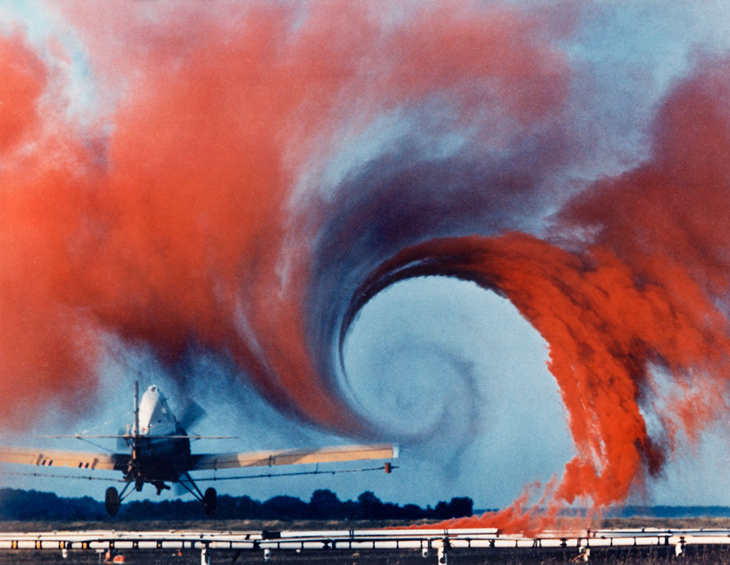
An aeroplane will produce vortices from the moment the nosewheel is rotated off the ground until the nose wheel is once more placed back on the ground on landing. The size of the vortices will be affected when the aeroplane comes close to the ground as the vortices will be contacting the ground and preventing them from fully forming.
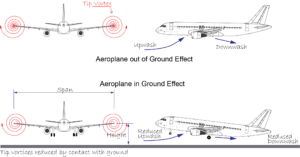
When the vortices are in contact with the ground less upwash and downwash will be produced. The reduction in upwash and downwash becomes significant when the aeroplane is within half a wingspan of the ground, so low wing aeroplanes will be more affected than high wing aeroplanes.
There are three things that occur as the aeroplane comes into ground effect. Firstly, there will be an increase in lift, secondly a reduction in drag and finally a nose down pitching moment.
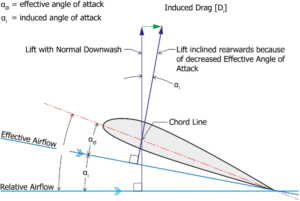
In flight the vortices cause the relative airflow to upwash and downwash creating the effective airflow you can see in the next diagram. The angle between the relative airflow and the chord line is the angle of attack, as always. The difference between the effective airflow and the chord line is the effective angle of attack. The difference between the effective airflow and the relative airflow is the induced angle of attack. From the diagram the effective lift is less, and its force is tilted rearwards from the relative lift vector, and this rearward force is induced drag.
As we come into ground effect the vortices and the upwash/downwash reduce causing the effective airflow to move towards the relative airflow causing the induced angle of attack to reduce and the effective angle of attack to increase, increasing the effective lift on the aeroplane. As the effective airflow moves towards the relative airflow the induced drag vector will reduce, causing induced drag to reduce.
As downwash from the wing reduces, we also create an angle of attack change on the tailplane. The angle of attack will increase, decreasing the tail down force and pitching the aeroplane nose down.