

Piston Engines – Compression Ratio
Why are we interested in the compression ratio of a piston engine? Density.
The power produced by a piston engine is directly proportional to the air/fuel mixture that is burnt on the power stroke. The mixture is achieved BY WEIGHT. Therefore, if the density of the air is high it follows that more fuel can be mixed with it and therefore more power is produced.
Are there any problems associated with high compression ratio?
There are – if you manage to increase the compression to the point where the construction of the engine cannot cope you will have destroyed your own engine. This is not considered an intelligent thing to do!
The more the compression ratio the more stain on the working parts, and although you may not have reached the destruction point there will be a maintenance penalty with worn out bearings requiring replacement sooner than would normally have been the case.
How can we calculate Compression Ratio?
There is a formula, but first some terminology.
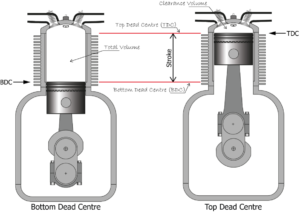
Where the diagram shows BDC, all that area from the top of the cylinder to the top of the piston is call the Total Volume.
The area shown at TDC is the Clearance Volume.
The Swept Volume is the difference between the two as shown.
The formula for calculating Compression Ratio is:
Compression Ratio = Total Volume
Clearance Volume
As you can see, given 2 of the 3 volumes you can calculate the volume that you need to complete the formula.
Example 1:
Swept Volume of a cylinder is 1500 Cubic Centimetres (CCs)
Clearance Volume is 500 CCs
What is the Compression Ratio?
Formula = Total = 1500 + 500 = 2000 = 4:1
Clearance 500 500
Example 2:
Total Volume 3000 CCs
Swept Volume 2500 CCs
Total – Swept = Clearance
300 – 2500 = 500
3000 = 6:1
500
Your Instructor will (no doubt) make you practise this until it “clicks”.
Still unsure which revision method is right for you? Get expert guidance and structured support with our instructor-led online revision courses at evoATPL.com 1-1 or group sessions, ask questions in real time, and build the confidence you need to succeed in your ATPL exams.