

The Name, Reason and choice of Piston Engine Power Plant Augmentation
Introduction
The English language has been abused since its inception, and especially when it comes to technical terms. To augment a piston engine, we use one of two devices – they are generally named Turbo ‘Chargers and Superchargers. Notice that there is an apostrophe (‘) in front of the word Charger – this is often left out. The reason for it is to indicate that it SHOULD be termed Turbo Supercharger.
To be technically correct (and to comply with CAA/EASA exam terminology) there are 3 names for a Turbo ‘Charger and they are:
- Turbo Supercharger
- Turbo Charger
- External Supercharger
If the word Supercharger is used on its own, or with the word internal in front then it is a very different device as will be explained later.
We must examine the reason for wishing to augment the performance of a piston engine, because any addition to the engine will necessarily give a weight penalty and any complication will lead to extra maintenance and the possibility of problems. Unless there is a REQUIREMENT for augmentation it can be a self-defeating exercise.
The piston engine burns fuel mixed with air BY WEIGHT, and therefore any reduction of air density (and therefore weight of the air) will lead to a reduction of the fuel mixed with it and therefore a reduction in power. As aircraft climb this will happen. We can reduce this by compressing ambient air and increasing the density/weight using a mechanical device – the Turbo Charger or Supercharger. Which to choose? Read on.
Piston engines are mechanically relatively efficient, but they are terribly thermally efficient. Up to 40%of the available heat produced in combustion is ejected as exhaust, and this is a terrible waste. If we could press the waste product into service this could cut down the level of thermal inefficiency, and this is precisely what a Turbo Charger does.
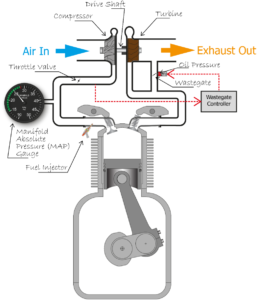
Looking at the diagram, you will see that the exhaust air can go either to atmosphere, or it can be channelled into a turbine which drives a compressor. The faster the turbine rotation the faster the compressor turns, and the more ambient air is compressed to increase its density. This will restore lost power because of increased altitude. The key to the restoration is a device called the WASTE GATE CONTROLLER and this will be explained by your instructor.
The cool part of this set up is that we can claw back some of the “lost” thermal efficiency, the drawback is extra weight and maintenance. If the engine is NOT fitted with an augmentation device it is called NORMALLY ASPIRATED. Engines fitted with a Turbo Charger are generally of the smaller capacity – but the is another way!
If your engine is of the higher capacity then it may be possible to tap some power off the crankshaft (something that leads to loss of mechanically efficiency) in order to replace, or possibly to increase the performance of a normally aspirated engine. This would not be done unless the payback was worth the extra weight/maintenance penalty.
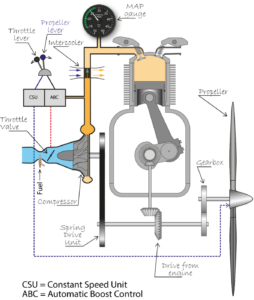
The MAJOR difference between the Supercharger and the Turbo Charger is that the Turbo only compresses air, whereas the Supercharger compresses air/fuel mixture. As you can see in the diagram, the key to this device is the Automatic Boost Controller (ABC) which is controlling the throttle valve. Although the pilot has the ability to move the throttle levers, the throttle valve is controlled by the ABC in order to prevent the possibility of OVER BOOSTING the engine which could lead to its destruction!