

INS vs IRS
In this blog we will have a look at the main differences between the INS (Inertial Navigation System) and the IRS (Inertial Reference System)?
Firstly lets look at the INS.
The INS is an old system – it is doubtful that you will see an INS on a commercial aircraft, but unfortunately the authorities still ask you about it in the exams!
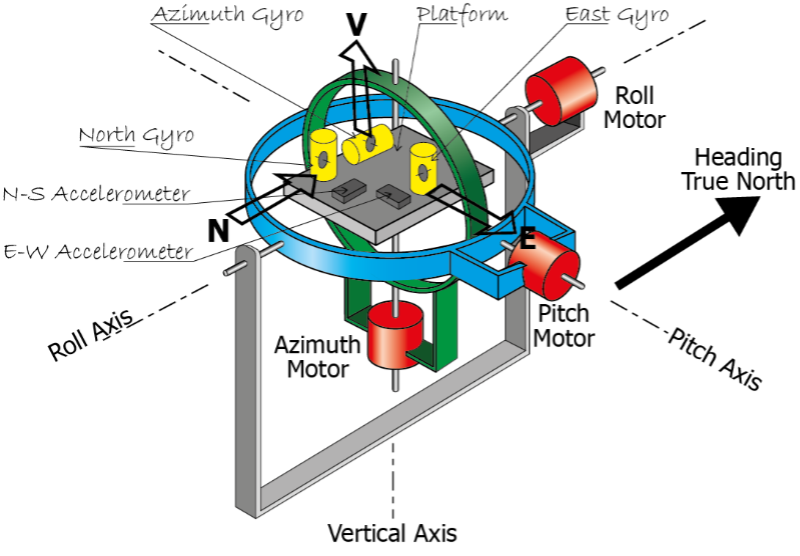
The INS was developed in the 1960’s and 1970’s and is known as a platform stabilised system.
A platform is kept stable and parallel to the Earths surface using 3 mechanical gyros, as well as keeping the platform pointing to TRUE NORTH. If the platform starts to topple or drift then the gyros are torqued using Torque Motors back to the level and pointing True North.
 There are 2 accelerometers on the platform, one aligned to North/South, the other accelerometer is aligned to East/West (the accelerometers are kept pointing North/South East/West as the platform is kept pointing at True North.
From these accelerometers we can work out our acceleration (acceleration x time = speed) and distance (speed x time = distance) travelled North/South and East/West and from geometry we can work out where we are – as long as we know where we started from.
The reason that the platform is kept stable and pointing True North is that makes the maths easier because when these systems were developed, computation was very expensive and not very powerful.
The IRS is a more modern system and will be integrated with the Flight Management System (FMS). It also uses three gyros but these are either RLGs (Ring Laser Gyros) or FOGs (Fibre Optic Gyros), they have less issues and more accurate than the mechanical gyros used in the INS. The INS was a stabilised platform system but the IRS is mounted in the aircrafts avionics bay and moves with the aircraft. Whereas the INS only needed to measure accelerations in N/S & E/W the IRS needs to sense movement in Azimuth as well. Thus the IRS has 3 accelerometers. As the computing power of modern systems is much greater than that of older systems, the IRS can work out the aircraft manoeuvring movement and isolate it from the navigation movement.
Both systems need a TAS input to work out groundspeed and thus wind speed and direction.
The IRS also needs an input of Barometric Altitude as the system has to work out Azimuth as it moves with the aircraft system.
| Issue | INS | IRS |
| Drift | Low – 1 to 2nm/hr | Very Low < 0.5nm/hr |
| Gyros | 3 x Platform mounted | 3 x Strapped to aircraft structure |
| Accelerometers | 1 x North/South,
1 x East/West |
3 x one in each axis |
| Datums | Gyro stabilised platform aligned to True North | Computed Mathematically |
| Earth Rate & Transport Wander | Removed by platform torquing | Computed (Algebraic Matrix Transformation) |
| Alignment | Takes 7 to 20 minutes (higher latitudes take longer) | < 10min as RLGs are quicker to align |
| Initial Position | Latitude must be correct (CAA/EASA within 10o) | |
| Construction | Complex and expensive to maintain | Mechanically simple |
For comprehensive ATPL revision, a complete ATPL question bank, and expertly written ATPL books, visit evoATPL.com
ATPL
ATPL Books
ATPL ebooks
ATPL Questions
ATPL Revision
ATPL Students
ATPL Study
General Navigation
GNAV
INS vs IRS
Students