

Departure
We know that for every 1° of latitude along a meridian a distance of 60 NM is represented. Only at the Equator does 1° of longitude represent 60 NM so, we have a problem calculating distance along a Parallel of Latitude.
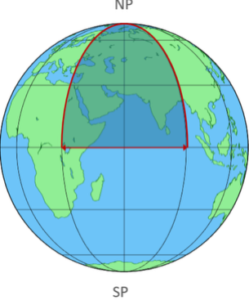
Departure results from the convergence of the meridians at different latitudes, and can be defined as:
The Earth Distance (ED) between two meridians along the same parallel of latitude (i.e. E/W distance) and is:
- Normally measured in nm
- Maximum at the Equator, where 1nm = 1 min Ch long
- Zero at the poles, where all meridians meet at a single point
- Departure decreases as the cosine of the Latitude
The formula for departure is:
Departure = Ch. Long (in minutes) x cos Lat
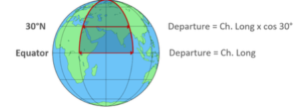
Ch. Long (mins) = Departure ÷ cos Lat
cos Lat = Departure ÷ Ch. Long (mins)
Note: It is important to remember that change of longitude is in minutes when used in Departure.
Example 1
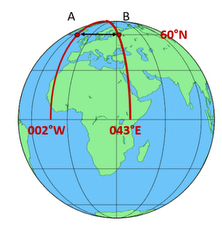
What is the distance in Nautical Miles between A (60°N 043°E) and
B (60°N 002°W)?
Solution
Departure = Ch. Long x cos Lat
= 45° x cos 60
= 2700’ x 0.5
= 1350nm
Example 2
An aircraft flies from A to B, tracking 090°T for 243nm. The change of Longitude is 4 degrees 45 minutes. What is the Latitude of A and B?
Solution
We know the departure and the Ch Long
So, we need to calculate the cos Lat, and thence establish the Latitude
Departure = Ch Long x cos Lat
cos Lat = Departure ÷ Ch long
= 243nm ÷ 4°45’
= 243nm ÷ 285’
= 0.8526
Go to your calculators (shift cos 0.8526 =)
0.8526 is the cos of 31.5, so the Latitude of A and B is 31°30’N (or S!)