In the last Gen Nav Blog, we looked at the theory associated with Lamberts Charts and we are now going to concentrate on Lamberts Chart calculations and how to tackle them.
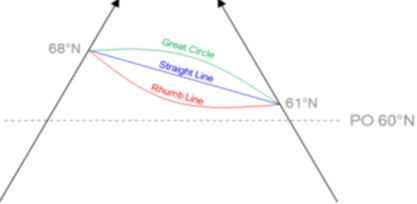
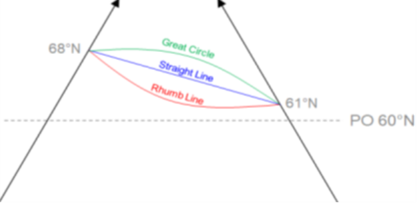
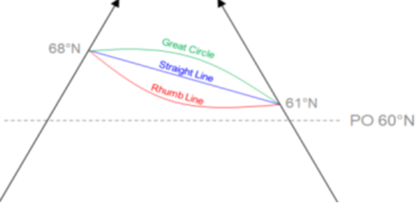
Example 1 A Lambert’s chart has Standard Parallels (SP) at 50°N and 70°N. A straight line is drawn from 61°N 040°W to 68°N 096°W. Where are the Great Circle (GC) and the Rhumb Line (RL) tracks in respect to the straight line?
Solution On a Lamberts Chart, all GC are actually slightly concave to the Parallel of Origin. The Parallel of Origin (PO) can be taken as the mid-Latitude between the two SPs: PO = 60°N Both points are North of the PO
The GC is to the North, and the RL is to the South of the straight line.
Example 2 A straight line (GC) is drawn from A (40°N 078°W) to B (52°N 130°W) which measures 334°(T) at A. The constant of the cone is 0.75. What is the direction at Point C which crosses the line at 100°W?
Solution
Step 1 Draw a sketch
Step 2 Find the Change of Longitude (Ch long): 100W – 78W = 22°
Step 3 Convergency = Ch long x Constant of the cone (CC) Convergency = 22 x 0.75 = 16° We can see that the angle at C is less than the angle at A, so334 minus 16° = 318°(T)
Example 3 A straight line (GC) is drawn from A (40°N 078°W) to B (52°N 130°W) which measures 334°(T) at A. The constant of the cone is 0.75. Point C crosses the line at 100°W. What is the Rhumb Line track from A to C?
Solution
Step 1 Draw a sketch
Step 2 Ch Long = 100W – 78W = 22°
Step 3 Convergency = Ch Long x Constant of the cone Convergency = 22 x 0.75 = 16° Conversion angle = ½ x convergency = 8°
Rhumb line track is therefore 334° minus 8° = 326°(T)
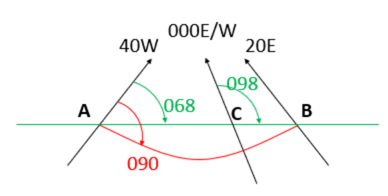
Example 4 A straight line is drawn from A (48°N 040°W) to B (48°N 020°E). The constant of the cone is 0.75. Point C crosses the line at 000°E/W. What is the GC track from A to C, at C?
Solution
Step 1 Draw a sketch
Step 2 Convergency = Ch Long (040W to 020E) x Sin PO= 60 x 0.75= 45 (44)
Step 3 On a parallel of latitude, the RL Trk A – B must be 090°(T) CA = ½ Convergency = 22° Therefore, the GC Track A-B must be 090° – 22° = 068°(T)
Step 4 Convergency between A and C = Ch. Long x sin PO: 40 x 0.75 = 30°
The angle measured at C is bigger than the angle measured at A, therefore, the GC Track at C must be 068° + 30° = 098°(T)