
Wake Turbulence
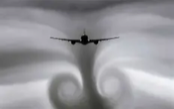
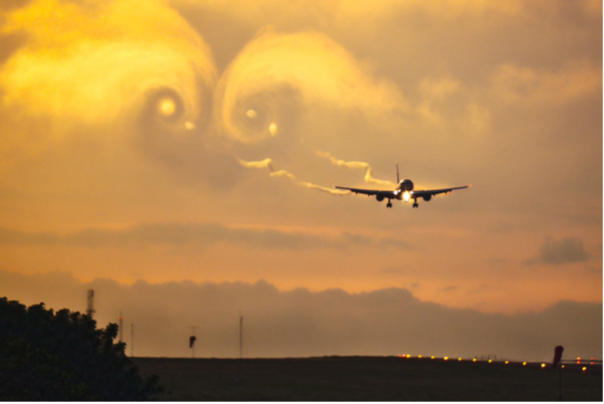
Wake turbulence is the term we use to describe the effect of the rotating air masses that are generated behind the wing tips of every aircraft.
Wake vortices can be found behind every aircraft but are more severe behind the larger aircraft.
The wake vortices are formed from the air from the area of high pressure below the wing up to and around the wing tip to the area of low pressure above the wing.
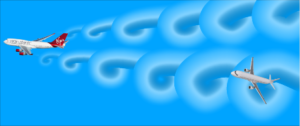
The characteristics of the vortex are determined by the aircraft gross weight, wingspan, airspeed, attitude, and configuration (a clean aircraft is worse).
The vortex generation begins as the nose wheel lifts off the runway on take-off and stops after the aircraft has landed.
Close to the ground the vortices move outwards from the aircraft at speeds of up to 5 kt. If the crosswind component is 5 kt then the upwind vortex will remain stationary underneath the flight path of the aircraft.
A light wind or no wind is worse as the vortices will remain stationary near the runway longer.
Away from the ground vortices tend to drift downwards and outwards and level around 1000 ft below the aircraft’s flight path.
Entering another aircraft’s wake turbulence can be quite unpleasant and you may experience un-commanded roll.
Wake Turbulence Category
Ther are 4 categories of wake turbulence defined by ICAO based on the maximum certified take-off mass of the aircraft as shown in the table below:
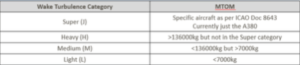
The UK CAA include the Antonov AN-124 Ruslan and Antonov AN-225 Mriya in the Super category.
Take Off – Wake Turbulence Separation Minima
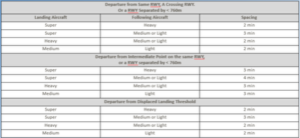
The table shows the minimum separation allowed between different categories of aircraft.
Landing – Wake Turbulence Separation Minima
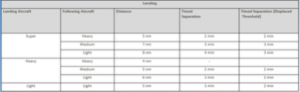
The landing minima apply when:
- An aircraft is operating or crossing behind another aircraft at the same altitude or less than 1000 ft below.
- Aircraft are using the same or parallel runways that are separated by less than 760 m.
Whilst we have only mentioned wake turbulence for departing and arrival aircraft, it is possible to encounter turbulence in busy airspace (e.g. The NAT HLA on the designated tracks).
As wake vortices travels behind and down from an aircraft it may affect aircraft behind but also1000 ft below your altitude travelling in the opposite direction.